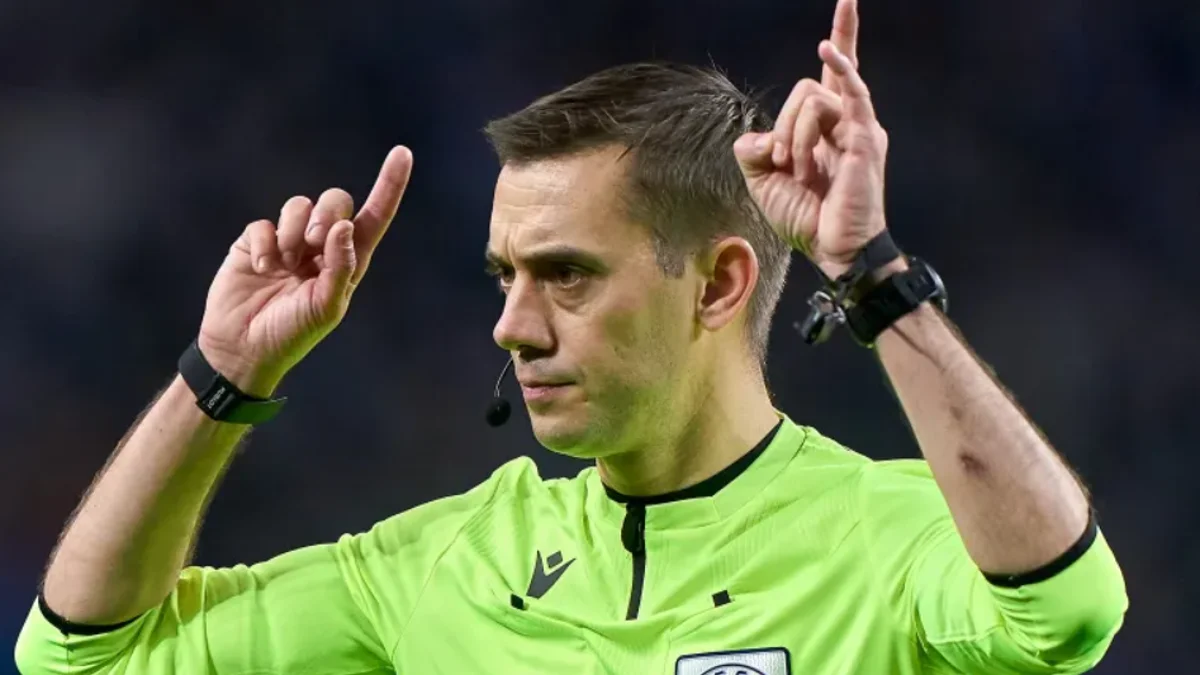


Paris Saint-Germain has lost two of its star attacking players to serious knee injuries within a single month, after Khvitcha Kvaratskhelia was hurt on 20 October and Désiré Doué went down on Saturday in Nice.
PSG confirmed in a statement on Sunday that Doué, a 21-year-old France international, had suffered a rupture of the anterior cruciate ligament in his right knee. The club said he would undergo surgery before the end of the month.
Doué and Kvaratskhelia are the two wide forwards who have driven PSG's run of back-to-back Champions League campaigns. A slim hope remains that Kvaratskhelia could be fit for the Metropolitano in Madrid on 5 June, should PSG reach a third consecutive Champions League final, but Doué is unlikely to be seen again this season.
There is one small mercy in Doué's case. He was not injured in the patella tendon or the meniscus, damage that would have carried even heavier consequences for his career.
How long other stars were out
Looking back over the past twenty-five years of top-level football, recovery times from a torn anterior cruciate ligament have typically run between 190 and 270 days, roughly six and a half to nine months.
Neymar's absence stands out as the longest of the group. The Brazilian missed 340 days, more than eleven months, between the end of 2023 and the end of 2024 after tearing his anterior cruciate ligament and his meniscus in the same left knee during a Brazil-Uruguay World Cup 2026 qualifier.
At the other end, Radamel Falcao returned in 190 days, clearly rushing to be fit for the 2014 World Cup with Colombia. Italy forward Federico Chiesa needed 270 days. Back in 2002, Robert Pirès got back on the pitch after 213 days, almost exactly the same recovery time as two more recent cases, Lucas Hernandez of PSG at 215 days and Rodri at 220 days in 2024.

Will Doué keep his explosiveness?
The biggest question hanging over Doué since Sunday is whether a dribbler of his quality will fully recover his explosiveness after such a serious injury. It is impossible to answer that with certainty, even for the most respected doctors in the world.
There is reason for optimism. Pirès was already a 1998 World Cup winner and a Euro 2000 winner before his first cruciate ligament rupture, and he went on to produce the best club season of his career immediately afterwards, as part of Arsenal's unbeaten Invincibles side of 2003-2004.
Virgil van Dijk offers another hopeful example. He was essential to Liverpool's title-winning side in 2025, and Rodri was named best player at the most recent World Cup, both players showing they could recover their best level, at least in spells, after a similar knee injury.
The more pessimistic cases are Nabil Fekir, who never fully recovered the magic of his 2014-2015 season at Lyon, and Federico Chiesa, who has struggled since his injury in 2022.
Other reasons for hope
Supporters hoping Doué follows a brighter path point to Antoine Dupont, captain of the French rugby team, who has returned to brilliant form after each of his knee operations, in 2018 and in 2025.
There is also the case of Lens full-back Matthieu Udol, 30, who was never closer to a France call-up than after his fourth cruciate ligament rupture.
What happens next
PSG said Doué will have surgery before the end of the month and is unlikely to play again this season, while Kvaratskhelia has a slim chance of being fit if PSG reach a third straight Champions League final on 5 June in Madrid.
Test yourself
Which PSG player did the club confirm had torn his ACL on Sunday?
How many days was Neymar out after his ACL and meniscus injury?
How long did Robert Pirès take to return from his 2002 ACL injury?
Have your say
Do you think Désiré Doué will return to his previous best level after this injury?
Where it happened
Paris, France