

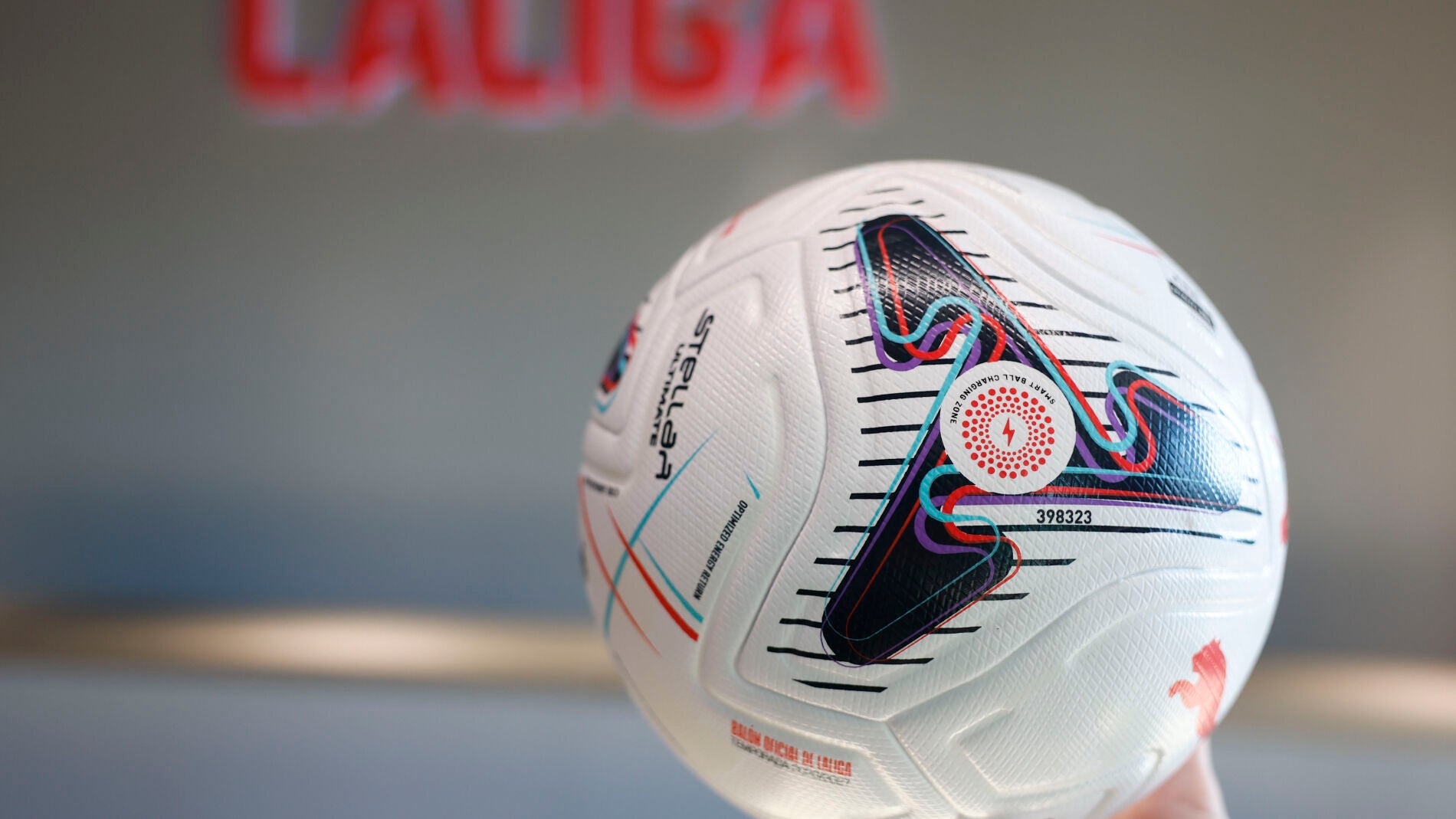
LaLiga presented a new connected ball featuring an internal sensor on Wednesday, becoming the first domestic league in the world to implement the technology.
The system, developed by technology company Kinexon according to an official statement, enters service in Spain's Primera Division on Friday.
LaLiga announced the initiative at an informative breakfast, explaining that the tool will support refereeing. The deployment requires significant technological logistics in stadiums and strict coordination among LaLiga, the Royal Spanish Football Federation (RFEF), and individual clubs to ensure perfect system synchronization and correct performance.
The ball used in Primera Division starting Friday carries a 25-gram sensor combining an accelerometer and a gyroscope to measure force and speed, news agency Efe reported. The technology will expand to Segunda Division next season.
Tracking technology and antenna layout
Data from the ball is sent to 12 antennas installed in each of the 20 LaLiga EA Sports stadiums. Three antennas are placed behind each goal area and three along each lateral stand to ensure full coverage and triangulate the position of the ball at all times.
Luis Mosquera, football data and technology expert at Kinexon, explained that the ball transmits 560 signals per second to the antennas and sends positioning data at 100 signals per second. Synchronized antennas connect to stadium servers to assist Video Assistant Referees (VAR) with impact and location data.
Mosquera said that the data flow and camera images are synchronized using precision time protocols alongside ball information, delivering real-time data to the VAR room to make appropriate decisions.
Eduardo Prieto, VAR chief at the CTA-RFEF refereeing committee, said VAR officials completed a training program to inspect system signals. Prieto explained that referees must face two main challenges: ensuring permanent signal reception while checking correct system synchronization, and interpreting received data to apply signals to match events.
Charging stations and stadium logistics
Each ball requires wireless charging, reaching full capacity in 90 minutes to provide five hours of battery life. Stadiums will feature cabinets containing 20 wireless stations to charge, store, and inspect balls to confirm optimal conditions under the usage protocol.
LaLiga confirmed it is prepared for all venue scenarios regarding Rayo Vallecano. The Community of Madrid temporarily revoked the club's concession for Vallecas Stadium over hygiene and safety concerns, potentially forcing Rayo to start the season at Butarque in Leganes or El Plantio in Burgos. LaLiga stated the tracking technology will be operational wherever Rayo plays.
Ricardo Resta, director of Football Intelligence at LaLiga, said extensive testing was conducted on stadium devices and match balls with several clubs. Validation tests and blind trials with players confirmed no perceptible difference in ball feel, trajectory, weight, balance, or general playing experience compared to standard balls.

Matchday custody protocols and fan experience
Resta stated that the tracking system is currently the most reliable and robust technology available, revealing that radio frequency interference tests were conducted with police collaboration.
A strict matchday custody protocol begins four hours before kick-off to check ball charge levels. Standard balls are removed after pre-match warmups and replaced by 14 connected balls positioned on dedicated supports at 12 perimeter points around the pitch. Ball kids will remain on duty to monitor stray balls and return them quickly to perimeter stands.
Officials will check every ball again at halftime before returning all 14 balls to storage cabinets at the end of the match.
LaLiga explained that the innovation aims to make football more understandable and accessible for supporters. Fans will receive more information, emotion, and insight during match events.