
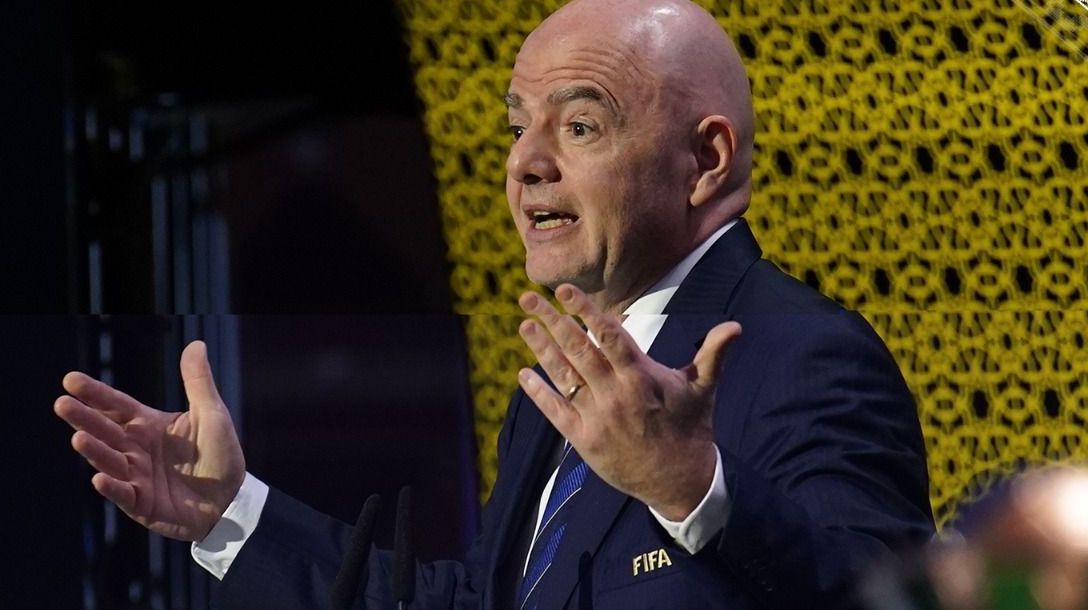
FIFA president Gianni Infantino is resisting mounting pressure to step down, despite backing away from a plan to sell parts of the World Cup and other flagship FIFA events to private companies, and despite a renewed boycott threat from UEFA, European football's governing body.
Infantino issued an apology statement last week and pledged not to let the situation repeat itself. That has done little to ease the scrutiny over his leadership, according to the report.
UEFA has reinforced its threat to boycott FIFA competitions, and battle lines are being drawn across global football. It remains unclear whether Infantino's latest move is a genuine retreat, a stalling tactic, or the opening of a prolonged war of attrition.
A fragmented landscape
Before this summer's World Cup, more than 200 of the 211 national associations that make up FIFA had reportedly declared support for Infantino's re-election next year. Until now, the 56-year-old had appeared untouchable.
Concerns over his close ties to US President Donald Trump, anger over high ticket prices and immigration policies during the World Cup, and unanswered questions about the overturning of Folarin Balogun's suspension during the tournament had largely been swept aside.
The dispute over privatizing parts of FIFA's flagship events tested that position. UEFA has mounted a coordinated effort to remove Infantino, including a loss of confidence in his leadership and the threat of legal action against him and his associates, but no united front against him has emerged.
Power bases outside Europe
Outside Europe, only Jordan, one of the few countries that had not signed a letter supporting Infantino's re-election before the crisis, has publicly called for his resignation.
CONCACAF, which governs football in North America, Central America and the Caribbean, and the Asian Football Confederation have criticized the FIFA president and rejected the privatization plan. Several countries within both confederations, however, have already declared loyalty to Infantino, while others are in no hurry to commit either way.
Like his predecessors João Havelange and Sepp Blatter, Infantino is seeking to mobilize support in his traditional power base in Africa. Poorer associations there and elsewhere have relied heavily on FIFA funds through the Fifa Forward program, which Infantino introduced in 2016 as the precursor to the newer FFE plan.
CONMEBOL, South America's governing body, has said it will not disturb the current balance of power while it continues pushing for a 64-team World Cup in 2030. The Oceania Football Confederation's executive committee, representing the smallest and least wealthy regional confederation, is set to meet Wednesday to discuss its position.
A numbers game
Despite being significantly weakened, Infantino still has allies and, as things stand, believes he has the votes needed to win the presidential election in March. Internal pressure within FIFA appears to have eased for now, even as some senior figures have spoken out while others have fallen in line.
Carlos Cordeiro, a former senior adviser to Infantino, remains the only high-profile official to have resigned so far.
The decision on what to do next rests with UEFA. It could try to call an Extraordinary Congress and force a vote of no confidence in Infantino, and has the numbers to trigger one, though success is not guaranteed. Forcing an emergency meeting of the FIFA Council is another option, but securing enough support may prove difficult.
The likelier path is a rival candidate challenging Infantino in March, which would mark the first contested FIFA presidential election since Infantino succeeded the discredited Blatter in 2016. CONCACAF president Victor Montagliani is widely seen as the most probable challenger if enough votes can be gathered, though he has not yet publicly addressed the privatization plan or offered an alternative vision. Candidates have until November 18 to register.
The nuclear option
That timeline gives Infantino room to weather the storm, regroup and rebuild. He could offer a path to reform, open FIFA's financial reserves, or promise new funding, with all options reportedly on the table.
The key question is whether UEFA follows through on its boycott and non-cooperation threat, which could make FIFA ungovernable for Infantino. It is a lever Europe can pull, but a risky one.
A first major test of UEFA's resolve is whether its national teams take part in next month's Women's Under-20 World Cup in Poland. Six nations, including host Poland, are expected to compete, though UEFA has not publicly confirmed how it plans to handle the tournament. CNN said it contacted FIFA and the Polish football federation for comment.
Discomfort among FIFA's lucrative sponsors over the ongoing negative publicity could also prove decisive. For now, football's internal conflict appears headed toward an entrenched standoff.