

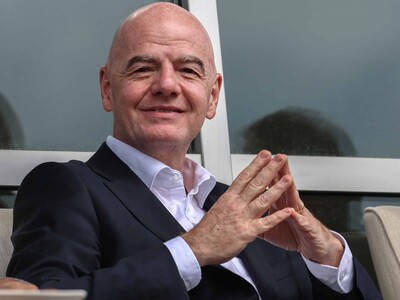
FIFA president Gianni Infantino withdrew a controversial plan to open the organization's competitions to private investors, but the Union of European Football Associations (UEFA) and the Confederation of North, Central America and Caribbean Association Football (Concacaf) said Saturday that they no longer trust him because of the episode.
The two confederations, representing European football on one side and North American, Central American and Caribbean football on the other, kept up their pressure on the Italian-Swiss official. Infantino faces growing opposition less than a year before the end of his mandate and the March 2027 elections, for which he is currently the only candidate.
Plan withdrawn amid backlash
Infantino, a former UEFA secretary general, announced Friday night that he was withdrawing the project, which would have created a company called FIFA Forward Enterprise (FFE) open to private investors to manage FIFA's commercial and event activities, including the World Cup.
Infantino said that after listening carefully to all points of view, it had become clear the project had created divisions that no longer served its original purpose.
The proposal, revealed on Tuesday to general surprise, was rejected en masse, mainly by UEFA. The body had even threatened on Thursday, unanimously, not to take part in future FIFA competitions, including the World Cup, if the project went ahead.
Conflict of interest concerns
One of the biggest criticisms of Infantino's plan centered on alleged conflicts of interest, since the potential investors included Thrive Eternal, a fund created by Joshua Kushner, the brother of Donald Trump's son-in-law. The U.S. president is close to Infantino, who emerged weakened from the episode after opposition from numerous federations and the resignation of his chief advisor, Carlos Cordeiro.
UEFA demands accountability
In a statement published Saturday, UEFA, which represents 55 European federations, called the abandonment of the plan a victory for all football, but said it should not mark the end of the story. The organization said the proposal had been rejected but that the task of restoring trust in FIFA had only just begun.
UEFA, led by Slovenian president Aleksander Ceferin, said that before his 2016 election, Infantino had defended transparency and promised that FIFA's money belonged to the member associations. UEFA said he had not kept those two promises, describing the plan as a shoddy, opaque project drawn up behind closed doors that was anything but transparent.
Calls for a new funding model
UEFA said the abandonment of the plan should lead to a new method of distributing resources through the existing FIFA Forward program, using part of FIFA's reserve funds, estimated at $5 billion. UEFA said FIFA needed to start using money sitting idle in its bank account to boost grassroots football across all 211 FIFA member countries, but added that FIFA did not need to sell the family silverware to pay for it.
The English Football Association (FA) and Germany's Deutscher Fussball-Bund (DFB), two influential UEFA members, also criticized football's governing body. DFB president Bernd Neuendorf said Infantino had acted unilaterally, without transparency and, ultimately, irresponsibly. The FA said it was time for a thorough and rigorous review of FIFA's direction and governance to ensure world football is run transparently.
Concacaf and AFC weigh in
Concacaf, which hosted the 2026 World Cup across the United States, Mexico and Canada, said a proposal of this magnitude did not reach that stage by accident, and reflected leadership that had stopped putting football first. The confederation, without naming Infantino, said the time had come for a comprehensive review of that leadership.
The Asian Football Confederation (AFC) also welcomed the withdrawal of the project, calling for collective dialogue and respect for football's governance structures. The African and Oceania confederations had been far less critical in recent days, asking their member associations to examine and evaluate the project, while South America's CONMEBOL requested additional information and clarifications.
What federations stood to gain
Had the project gone ahead, each FIFA member federation could have received an exceptional payment of $20 million in early 2027, and seen its allocation for the 2027-2030 period rise from $8 million to $20 million.


