In football, a new term is SAOT. We tell you what it is.
The UEFA Super Cup match in Helsinki will be the first to officially feature semi-automatic offside detection (SAOT) technology. This is the third technological novelty that FIFA rolls out with a strict frequency of four years, starting in 2014.
Every four years – a new football “gadget”
Then the automatic goal control system (GLT) was introduced. Four years later, after numerous tests, the Video Assistant Referee (VAR) system was implemented. Each of the technologies deliberately appeared in the year of the next World Cup. And in 2022, first in Helsinki, and by the end of the year in Qatar, SAOT will start working.
You can clearly see the evolution of the developments that are being carried out under the leadership of Johannes Holzmüller, director of football technology and innovation at FIFA. If the first system, GLT, had a clear technical focus, the second, VAR, assumed the introduction of a new profession into football, then the third becomes a synthesis of two directions. In SAOT, a person sitting in the VAR center receives a signal from the machine, assesses the situation and transmits the data to the judge in the field.
This is precisely why the system is called “semi-automatic”: FIFA’s artificial intelligence has learned to determine that the player of the attacking team is closer to the goal at the time of the pass, but the decision to stop the game after analyzing all the details is still made by people.
12 cameras, 638 movable tags and a ball with a chip
The existing technology for detecting offsides with the so-called “offside lines” does not work satisfactorily. In it, on the basis of television freeze-frames, video arbitrators manually put down points, according to which the computer program draws straight lines. The angles often do not allow for clear vertical projections from the body parts of the players to the plane of the field, and the red and blue lines that indicate the position of the attacker and the defender stick together in the picture and do not allow you to quickly figure out what’s what.
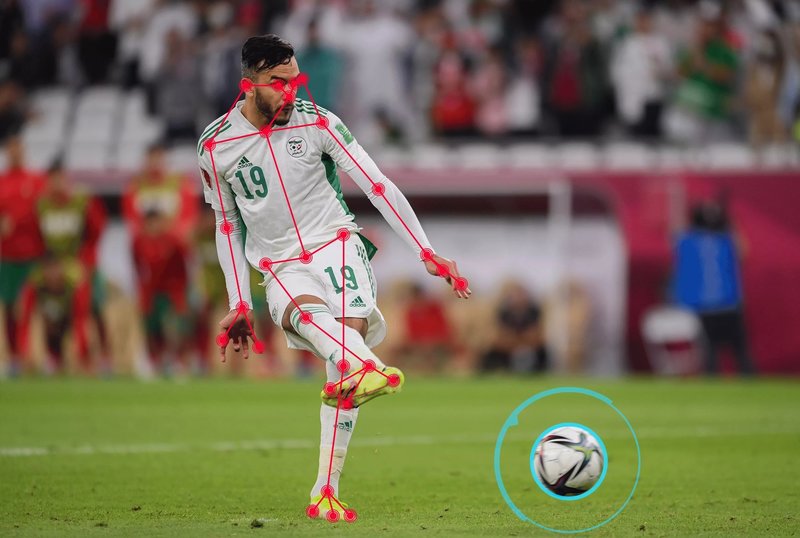
SAOT works differently. It uses not broadcast, but special cameras that are mounted around the perimeter of the stadium under the canopy. There are 12 of them. The system assigns 29 coordinate points to each player on the field, and these cameras continuously track the position of all these 638 marks in three-dimensional space at a speed of 50 times per second. And since the ball is known to move faster than any player, the system fixes the position of the ball 10 times more often – 500 times per second.

For this, a special high-tech ball had to be developed. This new addition, Al Rihla, has a distinctive look as usual, with patterns inspired by traditional Qatari architecture. But the most interesting is hidden inside. Strictly in the center of the sphere, a plastic core is fixed on special braces, in which an inertial sensor (IMU) and a battery are placed. The batteries of such balls can be recharged in an induction way, that is, contactless charging. A sensor with a frequency of 500 Hz transmits data about its location to the system, and the system combines them with data from coordinate points on the bodies of the players.
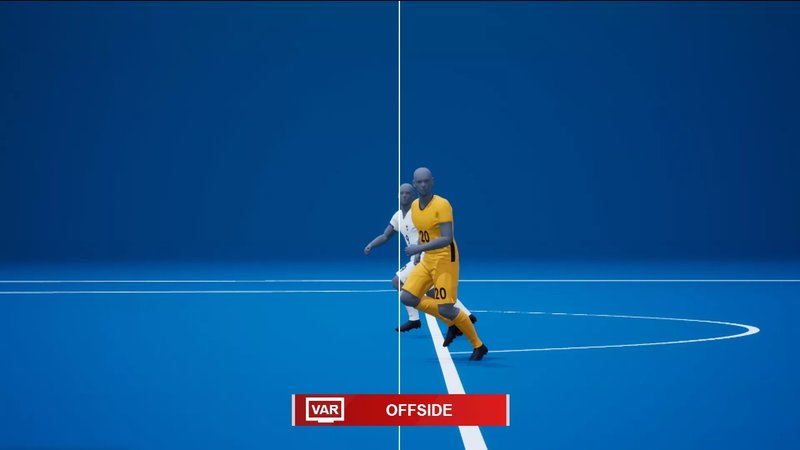
If a specialist in the video refereeing room confirms an offside position, the system draws an animated model of the situation: the figures of the players from several angles with a color accent on those points that cross not even a line, but an offside plane. These “cartoons” will be broadcast for the understanding of the fans on the stadium screens and, of course, will be included in the television broadcast. The developers claim that according to the results of 188 internal tests, the time for determining offsides is reduced on average from 70 to 20-25 seconds.
The system catches offsides on goals, but not on corners
On the one hand, the progress of technology is an inexorable and seemingly irreversible stream. And the application of SAOT technology fits into the same logic that justifies the already eight-year-old GLT: automatic control of the boundaries of the game. In the early case, the system keeps track of whether or not the ball has crossed a line drawn on the lawn. In the latter, whether the “invisible” border has been violated, because offside is nothing more than a kind of marking line of the field, only floating, not fixed. And in the business of spying on those frontiers, machines are understandably crowding out humans, because their sensors are so much more sensitive than ours.
On the other hand, questions remain. For example, it is not yet explained exactly how and at what point the system assigns coordinate points to football players. What happens, for example, if a player who has just come on as a substitute scores with the first touch, receiving the ball in a position similar to offside? Will the system have time to “register” it within itself? In addition, it is stated that SAOT will work within the framework of the VAR protocol, that is, in this case, only in situations where a goal is scored, a penalty is awarded, or there is a suspicion of a red card. Outside the system are, for example, earned corners. And if a ball is scored from a dubious because of an offside corner, and even a decisive one, it will not be possible to cancel it, and this will leave a residue of suspicion of injustice.
Finally, there is the question of how we will call the new technology in Russian. VAR has turned into VAR with us, there was no need to change it, since it is permissible to say “video assistant referee”. But with “semi-automated offside technology” something will have to be done. It will be possible to leave the English abbreviation. It is possible – to make its full PAOT tracing paper. Or you can shorten it to “PAT”, which will give a new meaning to the stable combination of the words “PAT situation” in the reports. Or before the POT, so that goals in football continue to be obtained by Sweat and blood.