Hockey
“They promised to blow up the car.” The hockey player figured out how not to pay the Russian mafia

Alexey Zhitnik / Photo: © Sporting News Archive / Contributor / Sporting News / Gettyimages.ru
Our hockey players in the 90s had a hard time even in the NHL – they had to share with crime.
To escape from the USSR and Russia of the dashing 90s for the stars of domestic hockey did not mean at all to completely break all ties with their homeland. Thanks to the fame of our NHLers, compatriots found them even across the ocean. And without any reason they demanded money from them.
“He should think about his future in Los Angeles”
Aleksey Zhitnik, defender of the Russian national team, loved fast cars, women, and also boasted about how much money he earns. This is one of the testimonies about the hockey player from the representative of the Russian mafia, which he gave in the US Congress.
Knowing what this would lead to, Zhitnik, for sure, would have tempered his ardor and behaved very modestly. But at 20, when he moved to Los Angeles to play for the Kings on a $400,000 a season salary, it was very difficult to do so. Until one day he was literally kidnapped by a group of compatriots, brought to a remote area of the city of Long Beach, and beaten. Having released the hockey player, the criminals demanded that he pay for the “roof”.
– A man named Sasha, who was associated with a Russian criminal group, contacted Alexei and demanded money from him, – this is how the representative of the Russian mafia continued his story in Congress. “And warned him to think about his future in Los Angeles.
Zhitnik called the Long Beach incident a “stupid incident” and called the mafia’s threats “more verbal than physical.”
“Yes, I had some problems with the Russian mafia,” he admitted to the Los Angeles Times. – They told me something like: “We’ll blow up your car.” Well, other things.
“If you have money, you automatically become a target”
Information about Zhitnik’s problems appeared simultaneously with similar news from Canada: the local newspaper Vancouver Province reported that the Russian mafia extorted money from Pavel Bure, who at that time played for the Canucks and was the highest paid Russian hockey player with a salary of 930 thousand dollars a year. It was also mentioned there that Zhitnik was also threatened and even beaten up by the hockey player. The Los Angeles police confirmed that they were investigating a case of intimidation of a hockey player, but did not specify his name.
Bure and Zhitnik’s agent Ron Salser declined to comment on the information, but in fact confirmed that there were problems:
“I don’t feel comfortable commenting on this,” he told the Los Angeles Times. There are problems, period. And, speaking in general terms, everything is very bad. This is the real Wild West. If you have money, you automatically become a target.
Zhitnik found an interesting solution to the problem
Despite his youth, Zhitnik approached the solution of the problem in a balanced way, and reasonably reasoned that it was not worth opening a wallet in front of such people. “Paying once, the next time you have to fork out more,” he said then. At the same time, the hockey player said that the police could not help, because those who threatened him were “outside the law and any rules.”
According to the North American media, Zhitnik contacted more powerful people in the mafia who solved his problem for him. According to the hockey player, in the end, financially, he did not suffer from an unexpected collision with a criminal gang.
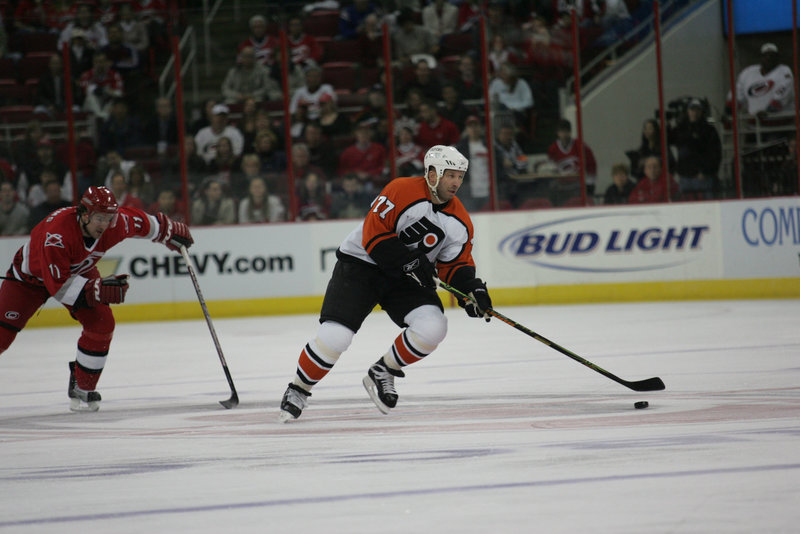
But the example of Zhitnik is almost the only public one. While more than 80% of players from the former Soviet Union have faced intimidation and organized crime according to the North American press, only a few details are known.
Why did the mafia need hockey players?
In the early 2000s, the North American media tried to understand the phenomenon of the Russian mafia, which regularly tried to establish connections with domestic NHL stars. Why did they do it? The obvious answer is money. Unfortunately for talented hockey players, their generous contracts became public on the day they were signed, so everyone knew about their real salary.
Other reasons include an attempt to recruit athletes in order to cash in on bets, or simply a desire to show off in the company of a celebrity, which would undoubtedly add points to the authority of any representative of the criminal world.
Regardless of the reasons, the theory of the American press about the massive intimidation of domestic hockey players was also confirmed by sources from within the mafia. It turns out that the hockey stars, seizing on big contracts, really had a hard time in the NHL.
“Professional hockey players from the former USSR are indeed victims of extortion,” admitted an anonymous source from criminal circles who agreed to testify in 1996. – And these extortions did not take place in Moscow or Kyiv, they took place here.
Source: Sportbox


I have been working as a sports journalist for about 6 years now. I currently work as an author at Sportish, which is a sports news website. I mainly cover sports news and I love writing about all aspects of the sport. I also have experience working as a broadcast journalist, so I have some great insights into how sport is reported and presented.